
Bishop James Walker Hood, 1902
Title: Bishop J.W. Hood, D.D.
Creator: Culp, D.W.
Subject: Hood, J.W. (James Walker), 1831-1918.
African American bishops
Description: Picture and brief biography of James Walker Hood, Bishop in the A.M.E. Zion Church, who lived in New Bern, N.C. Items appears to be clipped from Twentieth century Negro literature, or, A cyclopedia of thought on the vital topics relating to the American Negro edited by D.W. Culp (Philadelphia: Premier Publishing).
Publisher: Premier Publishing.
Date: 1902?
Type: Text and photo.
Format: 2 pages.
Identifier: Misc. Collection (#2)
Source: Donation.
Coverage: New Bern (N.C.)
Rights: Permission to use this item must be obtained from the New Bern-Craven County Public Library, 400 Johnson Street, New Bern, NC 28560.
Click on images below for more detailed images.
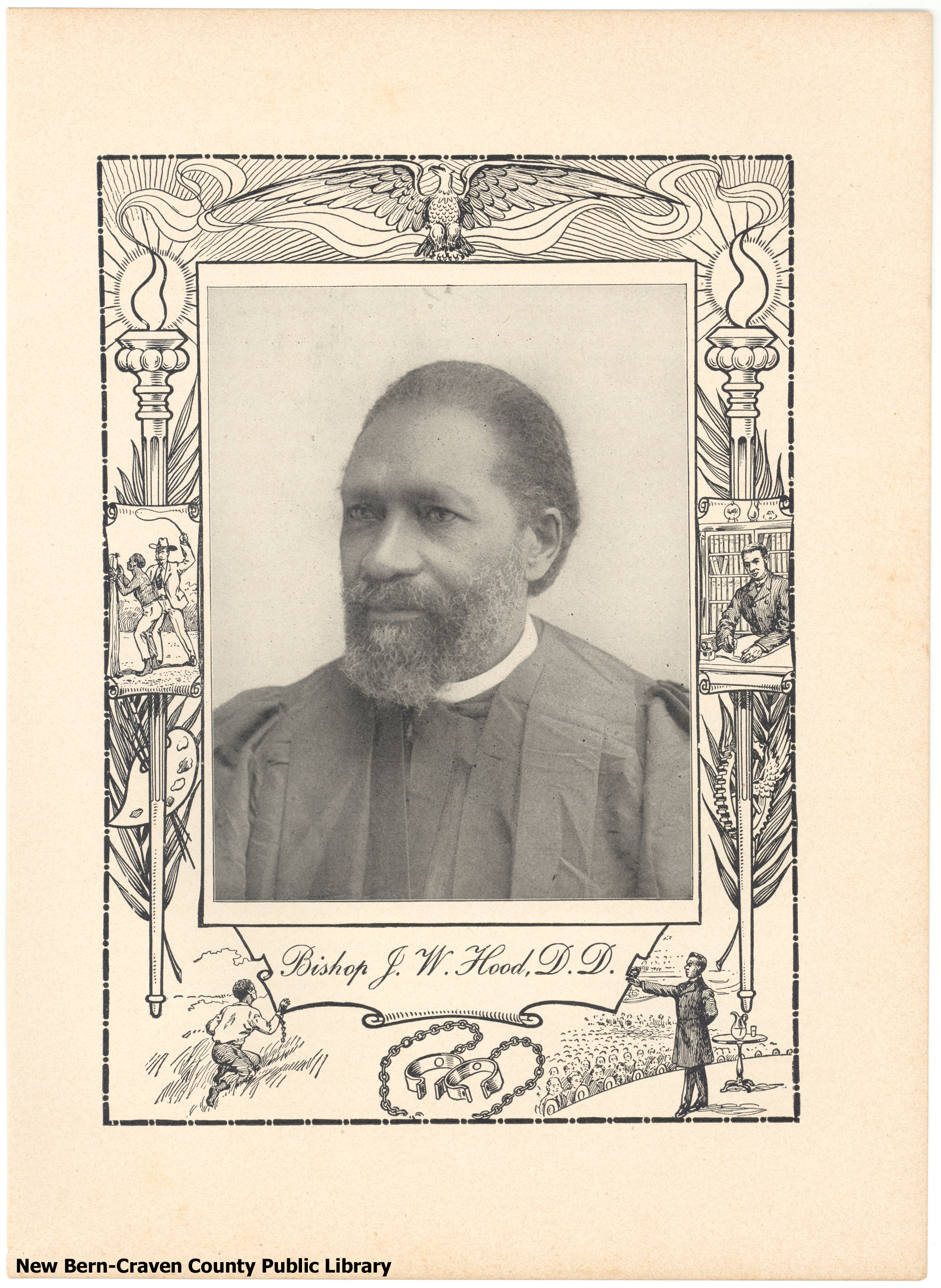 |
[Picture of James Walker Hood]
Bishop J.W. Hood, D.D. |
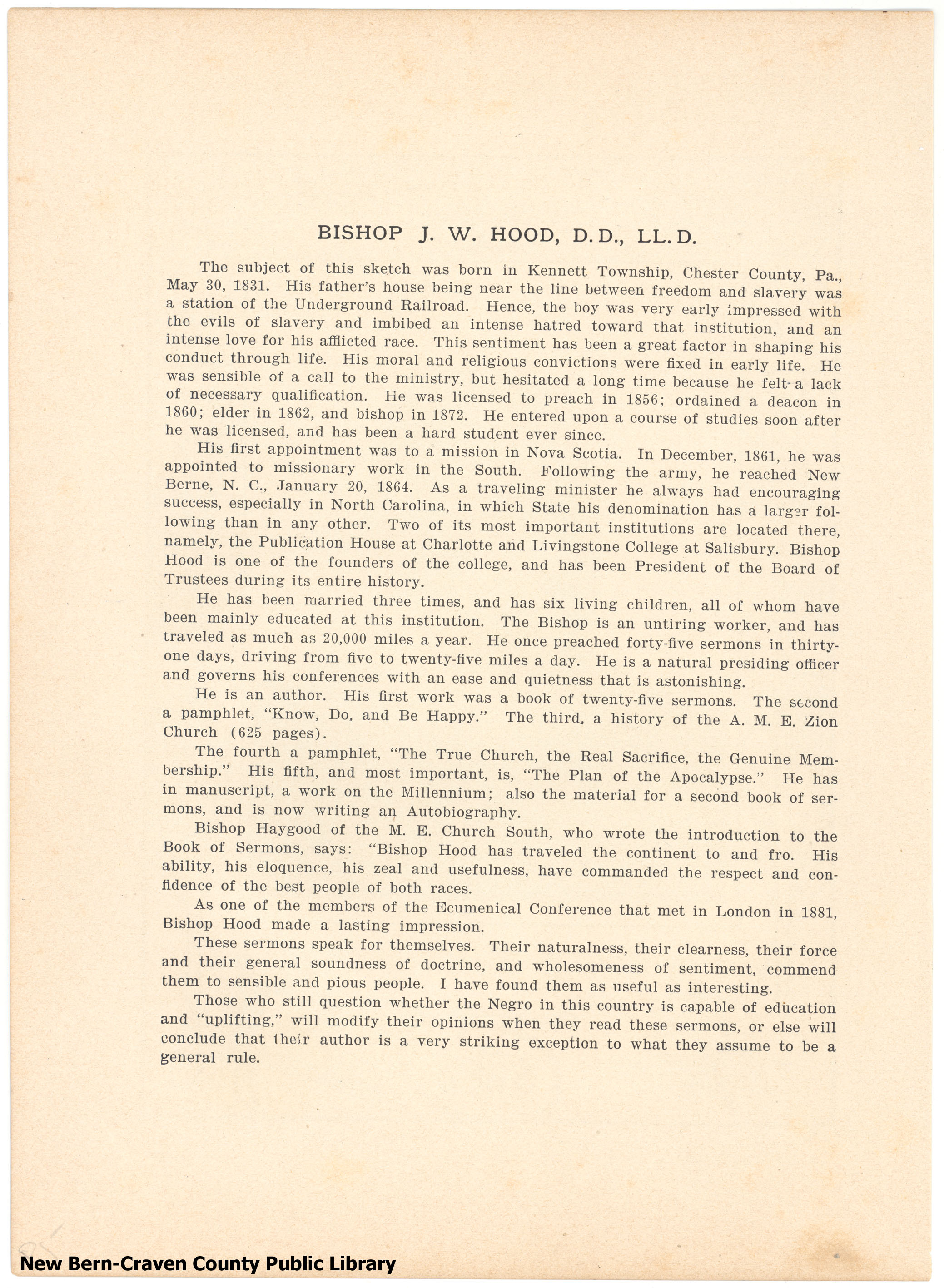 |
Bishop J.W. Hood, D.D., LL.D.
The subject of this sketch was born in Kennett Township, Chester County, Pa., May 30, 1831. His father's house being near the line between freedom and slavery was a station of the Underground Railroad. Hence, the boy was very early impressed with the evils of slavery and imbibed an intense hatred toward that institution, and an intense love for his afflicted race. This sentiment has been a great factor in shaping his conduct through life. His moral and religious convictions were fixed in early life. He was sensible of a call to the ministry, but hesitated a long time because he felt a lack of necessary qualification. He was licensed to preach in 1856; ordained a deacon in 1860; elder in 1862, and bishop in 1872. He entered upon a course of studies soon after he was licensed, and has been a hard student ever since. His first appointment was to a mission in Nova Scotia. In December, 1861, he was appointed to missionary work in the South. Following the army, he reached New Berne, N.C., January 20, 1864. as a traveling minister he always had encouraging success, especially in North Carolina, in which State his denomination has a larger following than in any other. Two of its most important institutions are located there, namely the Publication House at Charlotte and Livingstone College at Salisbury. Bishop Hood is one of the founders of the college, and has been President of the Board of Trustees during its entire history. He has been married three times, and has six living children, all of whom have been mainly educated at this institution. The Bishop is an untiring worker, and has traveled as much as 20,000 miles a year. He once preached forty-five sermons in thirty-one days, driving from five to twenty-five miles a day. He is a natural presiding officer and governs his conferences with an ease and quietness that is astonishing. |
| He is an author. His first work was a book of
twenty-five sermons. The second a pamphlet, "Know, Do, and Be Happy." The
third, a history of the A.M.E. Zion Church (625 pages).
The fourth a pamphlet, "The True Church, the Real Sacrifice, the Genuine Membership." His fifth, and most important, is, "The Plan of the Apocalypse." He has in manuscript, a work on the Millennium; also the material for a second book of sermons, and is now writing an Autobiography. Bishop Haygood of the M.E. Church South, who wrote the introduction to the Book of Sermons, says: "Bishop Hood has taveled the continent to and fro. His ability, his eloquence, his zeal and usefulness, have commanded the respect and confidence of the best people of both races. As one of the members of the Ecumenical Conference that met in London in 1881, Bishop Hood made a lasting impression. These sermons speak for themselves. Their naturalness, their clearness, their force and their general soundness of doctrine, and wholesomeness of sentiment, commend them to sensible and pious people. I have found them as useful as interesting. Those who still question whether the Negro in this country is capable of education and "uplifting," will modify their opinions when they read these sermons, or else will conclude that their author is a very striking exception to what they assume to be a general rule. |
|
Return to: Craven County Digital
History Exhibit
Return to: Ephemera Section of Digital History Exhibit
Return to:
Kellenberger Room
Images scanned by John B. Green, III. Text prepared by
John B. Green, III and Victor T. Jones, Jr.
This page last edited on
August 21, 2018.
This project is supported with federal LSTA funds made possible through a grant from the Institute of Museum and Library Services, administered by the State Library of North Carolina, a division of the Department of Cultural Resources through the North Carolina ECHO, 'Exploring Cultural Heritage Online' Digitization Grant Program.




Copyright © 2009-2015, New Bern-Craven County Public Library. All Rights Reserved.